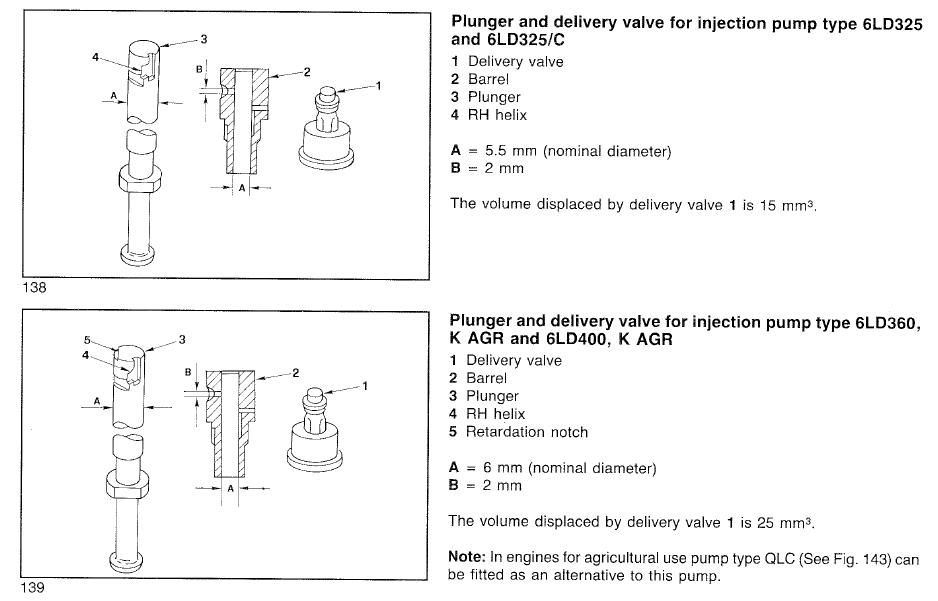
Interesting post Dave, well picked up on mate. I'll have to try and find a whole exploded view of the complete assembly to see exactly how they retard the plunger etc.
It would be good to have some sort of variable timing on these one cylinder engines. My ole thing is timed for top end speed, so its really rattly and knocky low in the RPM's.
I took the info from the Lombardini web site - they have all the engine manuals in PDF form.
There are various different regulators/pumps and injectors listed, interestingly there are specific details for the 'Automotive' uses.
For example the regulator spring is replaced by a plunger device that controls only the idle and maximum speeds - I suppose everything in between is down to the operators manual control.
There is also the mention of controlling fueling at low rpm, I suppose this is intended to prevent transmission 'snatch' from opening the regulator. I have noticed this phenomina when exiting the car park ramp at work, you only need to open the twistgrip slightly and the engine goes into full power mode as it tries to achieve the requested rpm.
I might see if the pump with the retard notch and matching injector are still listed as spares - might prove a useful upgrade.
There are also two types of regulator, generator sets requiring closer RPM control have a set of weights whereas the general purpose unit used ball bearings.
Perhaps a member who is using or considering a Winsun Vtwin should post a detailed reply to the new member from Winsun, suggesting the company produce a separate model fitted with the Lombardini type pump plunger. As stated in previous posts, this would transform the engine from a static rpm stationary engine to a variable rpm engine very well suited for motorcycle and micro automobile use. Moreover, this option should be a minimal cost for the factory and consumer.
After speaking with Lombardini suppliers in the UK the AGR type pump was only specified for the 325cc model.
It's not a sophisticated system, it just allows half timing for the first half if the rack movement. Reading through the manual is was specified for some of the engines required to pass EEC noise regulations so I'm guessing it will quieten the idle.
I found this discussion interesting and figured I'd bump it up again, hoping to get some more ideas and insight. I have a Lombardini 6LD360 that has an "automotive type throttle", it was originally used on one of these lighted roadside signs that are mounted on a trailer and used on highway construction sites, etc. It had originally a notched "cog" with a magnetic pickup similar to an electronic distributor's position sensor for RPM sensing and a very elaborate engine control (that I do not have) for the governor. Apparently they needed very accurate frequency control of the generator. These things were designed to run for weeks at a time unattended. I am installing it on a small tractor and after I get it going I want to pull it apart and see if it also has the advance control. I also have a Deutz/Ruggerini of the same size that is set up the same for the same use.
My old Hatz that is going into the bike runs smooth at 3000 revs, but has REAL BAD vibration at idle that I owe to timing advance. I was trying to come up with a separate manual advance control like the "spark" control on the old Indians and Harleys. I don't want to get off the bike after a long stop-and-go ride all "numb and tingley". I'll save that feeling for the pub AFTER the ride!
Sounds like a nice motor, the old 6LD motors are not too highly compressed at about 18:1 so they knock a lot less at idle than the newer generation type motors such as the Hatz that are over 20:1.
The higher the motor compresses the air then the faster the fuel will burn hence the motor tries to push the piston the wrong way but the flywheel keeps pushing it over TDC = heavy knocking.
You may have the automotive type springs/plunger assembly as there will only be 2 speeds required in the application you describe, idle and 3000 rpm, I doubt very much if the injector pump will have the retard notch as it would never have needed the extra low rpm torque and smoother idle that this would provide.
I had a long think about rigging a manual adv/retard unit a while back and could only come up with a huge screw thread into which the injector pump could be mounted and raised/lowerd to alter the timing. Other thoughts about applying variable cam timing seemed hugely complicated too. - hence the retard notch on the plunger seems too good to be true but this operates more simply, anything below 1/4 fueling is retarded and above this full advance - it's not RPM dependent.
Interestingly none of this will make the bike easier to kick start, you still have to get the piston travelling fast enough to get over TDC under flywheel momentum, but luckily as the decompressor is a manual version so you can bounce start the engine on the kick starter which you can't with the auto-decomp Hatz.
Thanks for your input Dave, I guess when I fire it up I'll be able to tell if it has a retard without pulling out the plunger just by seeing how smoothly it idles! After some thought, I doubt if it had the added complexity of the retard feature since this was really designed to run at one RPM, but very accurately.
I think that my Hatz E79 timing is adjusted by shimming the pump, not an easy thing to fudge with, but hopefully I won't have to spend much time at the stoplights. I bought a little handleld electronic tachometer so hopefully I will do a little testing to see how bad the vibration is at different RPM ranges. If I can get it within the vibration of a Harley I'll be happy, I don't expect much!
The Kubota 3 cyl. 950D tractor engine (future bike build) I have most likely has variable timing as it is the same engine as in my friend's Kubota utility 4-wheeler and his idles like a champ!