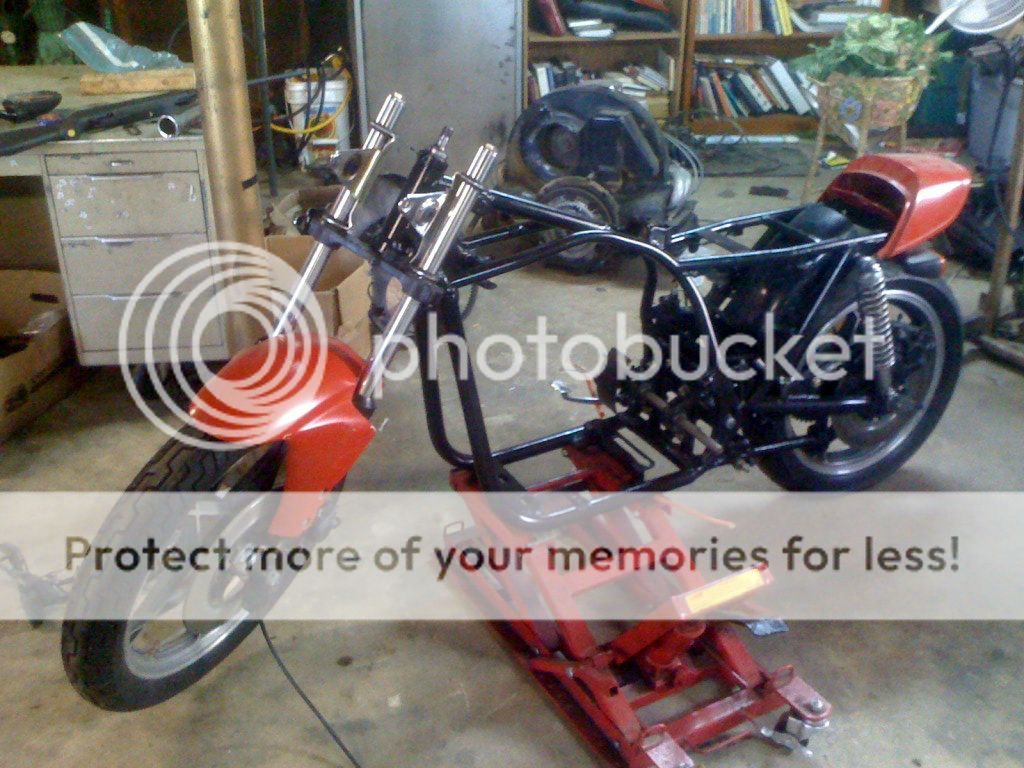
This bike was completed awhile back, but I'm in the process of making some improvements I could share. The original frame used angle iron. It was strong and simple to work with, but not very pleasing to the eye. I've replaced the angle with pipe to give it a more OEM look. The ability to slide the engine out the side has been retained.
For that matter anything less than 1.25 DOM with a .125" wall is probably insufficient for motorcycle frame construction. That's what everyone else is using, right?
I'm not a structural engineer, but according to my research the primary difference between "pipe' and "tube" is the way its dimensions are measured due their different intended purposes. Likewise, it is incorrect to say that pipe can never be safely used for structural, as it commonly is in industry, or that tube by default is superior, because with the exception of high grade tubing there is not much difference.
I'm not condoning anyone else using pipe in the manner I have. If I had access to better material locally I would have used it. However, I do believe this frame is sufficient for the application in question. All the same, thanks for taking the time to point out the potential dangers.
there is more to it than ID and OD. The way the tube is formed and metallurgy of the material used is a part of it too. Also Tube comes in grades of steel and not just wall width.
My point of this discussion was not to kick dieselbikin in da butt for potentially using pipe..... twas to take advantage of a learning moment he brought out into the open. Of course somewhere there is overlap in tube and pipe when it comes to structural integrity etc. both before AND after welding. (Welding's heat changes property of the metal )
Point is that since most of us don't know where the overlap of structural integrity between tube, pipe.. before/after welding, the overlap of each one's vibration stress characteristics etc. it is best to stick with tube at a grade, diameter, wall thickness similar to what bike frames are made of already. Would suspect that Any motorcycle fabrication shop uses tube!
No argument that it is best to stick with tube at a grade, diameter, wall thickness similar to what bike frames are made of already. Thanks for the link.
Coach... There is no real substitute for hands-on experience of working with these materials. Some of the guys on here (and I've had the pleasure of meeting some of the British, German and Scandinavian ones) live and breathe building and making stuff. Through both research and their own trial and error over the years, they know exactly what does and doesn't work in their builds, irrespective of what a website tells them. I frankly wouldn't have a clue myself as my interest and experience extends to basic engine mechanics, not metalwork, and I wouldn't question those in the know. Dieselbikin has a very impressive looking handmade frame sat in his garage and it sounds like you're telling someone with plenty of experience that they've done it wrong. I frankly doubt very much that is the case and hell, if it really is, then when he puts that (lightweight) engine in and sits on it he'll find out very quickly. And even factory-built Enfields flex in the middle!
re pipe v tube In the UK we call it a pipe bender whether you are using tube or pipe. I noticed coachgeo said something similar in another thread when someone in the UK said they had bought a pipe bender.
If you go to http://www.machinemart.co.uk and enter tube bender it will come up as pipe bender on the results.
It's just a colloquial UK term.
Without getting into technicalities about pipe or tube, pipe is generally softer and thicker walled and I think this is the point coachgeo is trying to put across especially for anyone who is starting out to build a bike with little or no experience and potentially end up with an unsafe bike.
dieselbikin looks like he knows what he is doing.
Sometimes it doesn't come across in print what someone is trying to say
Dan J wrote:Coach... There is no real substitute for hands-on experience of working with these materials. Some of the guys on here (and I've had the pleasure of meeting some of the British, German and Scandinavian ones) live and breathe building and making stuff. Through both research and their own trial and error over the years, they know exactly what does and doesn't work in their builds, irrespective of .......sounds like you're telling someone with plenty of experience that they've done it wrong. I frankly doubt very much that is the case and hell,
The tube vs pipe thread always raises hackles on folks necks no matter what board it is in; and it is in EVERY technical "build it" board have ever been on; which is approaching well over a dozen. Never commented in one till had read a goood thousand post in the tube/pipe debates. This being actually be the first one. So another words yeah.. my knowledge is all "academic" and not as much real world.
but... if you read back a few of my post you'll see it reads
My point of this discussion was NOT to kick dieselbikin in da butt for potentially using pipe..... twas to take advantage of a learning moment he brought out into the open.
that will clear up for you what the intentions of my post were. That damn "coach" thing is too thick in ma blood
This is kind of an apples to oranges comparison because the engine was a stressed member in the original design, but here is a picture of the original frame tubing next to the pipe which replaced it. Although it's difficult to see in the picture the original tubing has a raised seam which to the best of my understanding means it is not DOM tubing. Although there are a number of important metalurgical qualities to consider I can only share the two I'm able to measure.
OEM tubing 1.14" X 0.085"
Pipe 1.35" X 0.140.
I've horsetraded for a plasma cutter and larger 220V/175 amp MIG with Argon/CO2 since I built the frame, so I may add some gussets and go back over some of my original welds for better penetration.
That damn "coach" thing is too thick in ma blood http://www.custom-choppers-guide.com/erw-tubing.html





 no to pipe