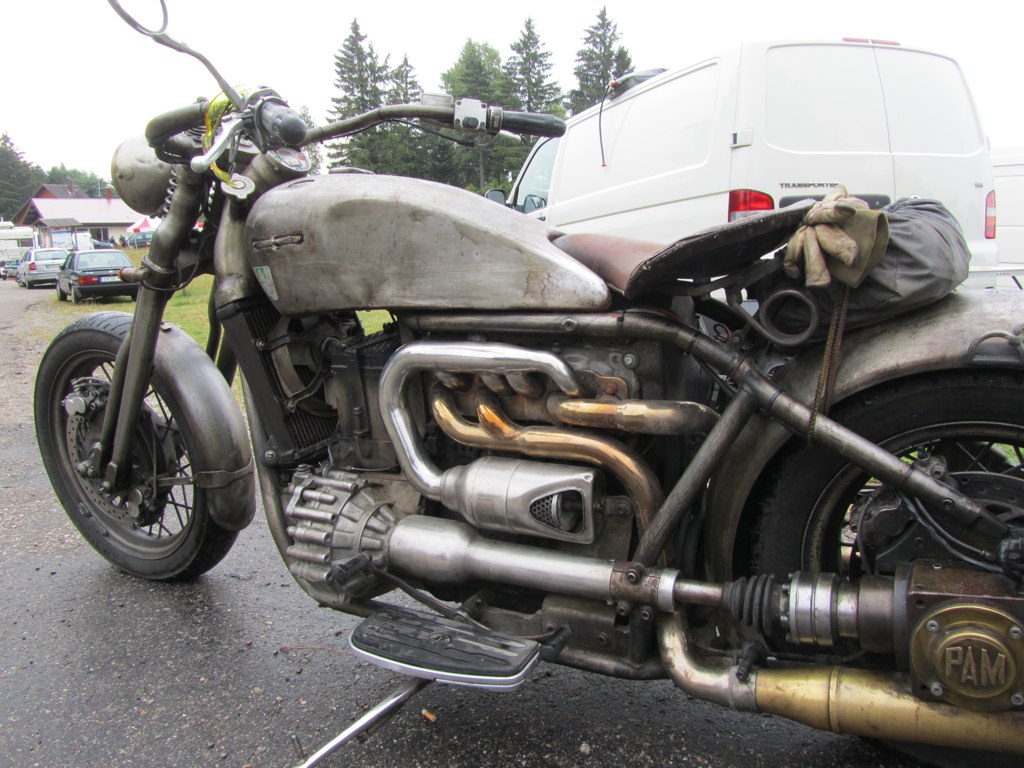
Here are some highlights/goals of this build:
- utilizes 3D CAD extensively for design, verification and visualization purposes;
- features a hand-operated clutch and a foot-operated sequential gear change with the stock car gearbox and clutch;
- utilizes stainless steel extensively (but not exclusively);
- utilizes car parts extensively;
- forgoes turbocharging;
- has cruise control;
- uses the engine/gearbox as load bearing members between the front and rear subframes;
- uses a modified bevel box from a combine harvester for the final drive;
- utilizes VW Golf CV joints and halfshaft for the driveshaft;
- the clutch is operated by a custom hydraulic force amplifier powered by a Golf mk3 power steering pump, using engine oil as working fluid;
- the gearchange is operated by a custom sequential changer mounted inside the oil pan;
- uses a custom made, thick steel load-bearing oil pan;
Now before continuing, let's review the events leading up to this:
Some 4 years ago, my father "wanted" to build an emergency electrical generator. By "wanted" I mean "he wanted it but was unwilling to pay more than about 1/15th of what it would actually cost to make". I tried to convince him that he needed a one-cylinder diesel but at $500+, those were "too expensive". So he wanted a car engine. But those were still too expensive at $200+. He wanted it cheaper. So he found a very good-looking 1.6D fiesta engine for roughly the equivalent of $85. You can see where this is going... when the engine was delivered, it was DOA with pretty much 0 compression throughout.
Soon afterwards he bought the generator head - that was a MASSIVE screwup, as it was supposed to be a 7.5kW unit but it was actually a 2kW unit. That's right, he didn't even check WHAT HE WAS BUYING from a TOTAL STRANGER - that's just how he is, and this was a recurring theme afterwards with his other purchases. So technically he was cheated, but as it was also his fault for not checking, and it was little more expensive than these actual 2kW heads are, we didn't pursue this any further.
So now we had a generator head that was totally mismatched to the engine, and a dead engine that would require some serious work to get it to work at all. Later I partially dismantled the engine and found that the cylinders and pistons are worn far beyond acceptable limits, and the valves are also seriously worn.
Interestingly enough the camshaft and followers showed only minor signs of wear, but it was clear that this would go WAY over the nonexistent generator budget. He gave the engine to me (for free) since he would have no use for it anyway.
At that time I wasn't even aware that diesel bikes existed. Later I found out that they actually do, and briefly pondered a bike with the Fiesta diesel - but dismissed it as totally impractical and likely impossible anyway.
Then I came across Gaz's diesel bike... with the same 1.6D Fiesta engine. And also the ratbike with a similar engine. So I knew it could be done - it HAS been done. But at the time I had no money, no tools and no workshop to work in, so the idea was still not realizable.
The first major break came about 2 years ago: a close friend of mine - who incidentally also has a house with a 2-car garage with one pit - decided that he's going to get the driver's license for bikes (we already had a license for cars, obviously). The reason: the rules pertaining to the license examinations were due to be radically changed next year, making it MUCH harder and also MUCH MUCH more expensive to get a driver's license.
And since I had enough money for this, I decided to hop on the bandwagon and also get a license for bikes. Through his connections we also managed to do it quite cheaply, and we lucked out A LOT and passed on the first try despite some minor complications, so a lot of the money I had saved for this was not used.
All this biking again made me contemplate building a diesel bike. For some time I considered doing it the "easy way": grab a brand new Punsun v-twin (approx. $1600 where I live), dismantle it, replace all the seals etc., tweak the injection system, maybe slap a turbo on it - another few hundred $ - and then put it in a suitable "donor" bike (another $2500+).
But I couldn't afford such large purchases up front, and the performance would be rather underwhelming, the engine would be extremely noisy, and it would look quite weird in an otherwise ordinary bike. And there was still that Fiesta engine taking up space in the shed.
If it weren't for that engine then I would have probably gone along with the Punsun build eventually - that is, when I could actually afford it. But I decided to start messing around with the engine I had. The first step was to find a suitable bevel box: I knew quite well that engineering and building a custom bevel box from scratch was financially out of the question.
Fortunately it didn't take me long to find a "local" company (only some 200km away) which makes various gearboxes for agricultural equipment. They had some nice bevel boxes in their catalog: small enough to fit on the bike yet strong enough to not fail immediately. And the price was quite affordable too - about $250 including fuel for the whole trip.
But I couldn't afford it at that time, so instead I found and bought the matching gearbox for the Fiesta engine. I already had the clutch and pressure plate (and they were OEM to boot!) - they came with the engine - so I didn't have to worry about that. But I wanted the 1.6D Fiesta Mk2 box - it had a 3.33 final drive ratio instead of the 3.82 used in the newer Mk3 1.8D Fiesta. This was especially important as the only usable bevel box ratio I could get was 1:1 - heavily suboptimal for multiple reasons, but I had to work with what was available (the next available ratio was 1.35:1 speedup, way too high).
It was initially quite hard to find a Mk2 box - Mk3 are plentiful, but Mk2 quite the opposite - but I got lucky and soon found one quite close to me (~100km) and for only about $60, so I picked it up.
Some time after that I could finally afford that bevel box, so I went to get it. So now I had the 3 major parts in my posession: the engine, the gearbox and the bevel box. I had plenty of time to waste so I did a lot of measurements on the engine and made a partial 3D CAD model of it. Not complete - that would be a waste of time - but sufficient for my needs. Then I started messing around with the CAD model, trying out various possibilities and verifying the required geometry of the bike.
Then came the next big break: my friend received an old, dilapidated metalworking lathe - for free. It was mostly complete but thoroughly shot, and I later spent a lot of time getting it to work - it's still not finished, and I need to add the threading capability to it. But it kinda works, so it's something. Makes parts out of round by over 0.05mm, but for many purposes that's good enough. And if you're wondering, that 0.05mm is AFTER I "fixed" the spindle - the whole spindle assy is shot beyond further repair and I would need to remake it from scratch.
Also around that time I managed to earn quite a bit of money by various means, so I could kickstart the whole build. I also had most of the required tools AND a potential place to work in (although this is a rather delicate issue at the moment), so I was good to go.
For the driveshaft I first bought a used long (hollow) halfshaft from a Golf mk2 at a whopping price of $3. I wanted to use a traditional configuration with a regular CV joint at one end and a plunge joint at the other end. But the amount of plunge motion available proved rather insufficient for the intended suspension geometry. With this my initial plan - to weld up the Ford diff, cut off part of the cup from the Ford inner joint, and weld the cup from the VW outer joint onto that - flopped quite badly.
So I decided that the only remaining possibility was to use 2 of these VW plunge joints on both ends of the driveshaft, doubling the available stroke.
Also I didn't like the idea of messing around welding up the diff - and the "floating" halfshaft could then still hammer the whole joint out of the gearbox end and cause lots of trouble. So I decided that the diff will be replaced by a "spool" - essentialy a solid shaft with a flange for the ring gear. This will stick out well beyond the gearbox oil seal and the CV joint hub/backplate will be attached with a locking assembly.
I tried to get another Golf mk2 halfshaft, but the local scrapyard had none left. So I settled for a Golf mk3 halfshaft - it's also hollow, and has the same OD, so there's no problem welding it to the mk2 halfshaft.
Incidentally, the reason I wanted these ugly hollow halfshafts instead of the solid ones was due to the required welding: trying to weld solid halfshafts is asking for lots of trouble - they like to break at the weld even when used normally, while I'll be putting effectively twice the intended load on it - but these hollow ones are factory welded right in the middle. The hollow section is a lot stronger than the solid section, so it can be cut and rewelded with relative impunity.
I finished designing the whole final drive arrangement just a few days ago. As it turns out, in this particular arrangement, only a few centimeters of the hollow section will remain, so I got quite lucky here.
Here's the preview:

And the cutaway view so you can see the internals:

(please ignore the weird, impossible geometry of the output shaft past the wheel hub - this is still WIP and I didn't get to dealing with that part yet; also the bevel box main housing model is only accurate from the outside - that's intentional)
A quick note here to those unfamiliar with 3D CAD software: the reason you see missing bolts, orings etc. in the design isn't due to me being lazy or something - it's due to software and hardware limitations. Every part added to the assembly increases the loading time due to the extra part files, makes rendering slower due to the extra surfaces, and increases the demand for system resources. That's why I skip such parts where possible, or use only one bolt/nut/whatever instead of a whole row for example. My draft "whole bike" assembly is still far from done and it already brings my computer to its knees even without all the extra stuff.
Now back on topic: the brake assy excluding the backplate is from an Astra G. The backplate is custom - I do have the stock backplate but there's absolutely no way of making it fit, short of using a 1000 ton press. Also it's thoroughly corroded anyway. The 14" rim and lug bolts are from an Astra F, which is incidentally the car I own. The tire in the image is a 175/80 R14 - quite a bit bigger than the Astra's 175/65. Yes, it's a car tire. Although I see that there are 180/80 bike tires available, so I'll probably go with that instead, at least initially - assuming it will even fit on the car rim.
The swingarm and associated hardware I will be dealing with later. The rear suspension will use 4 coilovers, 2 per side. Yes, it's wonky, but there is a good reason: knock-off replacement coilovers for lightweight bikes are dirt cheap. 4 of those still cost far less than 2 "big" coilovers and those are hard to get anyway. Also using 4 small coilovers makes the result somewhat narrower. And 4 of those should be just enough for the expected weight of the bike. And it gives me greater design flexibility anyway.
What I do know is that for the swingarm bushings I'll be using front control arm bushings from a Mercedes W124. Those things are MASSIVE - you have to see it to believe it - and if they can take the beating imposed by such a heavy car, they'll do just fine in this application.
Here's a sneak peek at the hydraulic force amplifier I mentioned earlier - it's still unfinished, but the most important part is complete:

The important part is that it requires <4kgf of pull to operate and it generates >150kgf of pull on the output, easily enough to operate the clutch. Also the working pressure is still below 1/2 the rated pressure of the power steering pump, to reduce noise, power losses and prevent rapid pump failure (yep they do that when fully loaded).
The Astra F alternator:

I got it for free - but it had a blown diode, otherwise it was functional, with the usual wear and tear. The pulley and nut are custom (stainless).
Also, the reason this model is so detailed - I did it as an exercise in accurately reproducing complex features, back when I was still learning to use the 3D CAD software. It worked out quite well.
Now for something interesting:

Yep, that's a viscous fan. And a Fiat Uno radiator. Got the fan - the smallest one I could find - and clutch for under $25 total, in very good condition. Radiator was free but "slightly" used, still serviceable though. It's nice because of the integral reservoir and because the size is a nearly perfect fit with this fan (although you can't really see it in this image).
Turns out that the water pump shaft on this engine is offset only 10mm to the left of the bike centerline (which is coincident with the camshaft centerline, which is itself 7.5mm right of the crankshaft centerline). So the radiator can be mounted dead center and it still won't be easy to notice the slightly offset fan.
I also have a 3D model of a Golf 1.9TDI turbo, and an actual - but shot - turbo from the same, and a VE4 injection pump - the same as in the Ford engine, but with an ALDA, so turbo-capable - but later on, for various reasons, I decided against turbocharging this bike. So none of that will be used here. Maybe in the next car or something.
There's much more to this build but I think that's about enough for now. Right now I unfortunately don't have much time for this due to personal reasons, but in about 3-4 months this should change for the better.
As of now there are still a few major unanswered questions about this build:
1. Fuel tank. I'd prefer a metal tank, but such tanks with the required capacity and also sufficiently large cutout are quite hard to find and/or very expensive. If all else fails I'll make a custom fiberglass tank, but I hate plastics in structural aplications - especially when there are liquids involved. I can't make a custom metal tank because I don't know crap about sheet metal work, so it would be just a waste of time and money.
2. Front suspension. The bike will be VERY heavy, in the 330-400kg range - all that cast iron and steel don't help things. Count me in at 100kg and we're talking about half a ton here. Also the handlebars have to be quite high off the ground, considerably higher than usual, due to the high seat height and overall front end design (so fork tube extensions then?). I'm open to suggestions on what bikes to look for as donors. Especially ones with inverted front forks, such as the ones in Gaz's Fiesta bike, since they're structurally superior to the usual design.
3. The battery. Obviously it must be a sealed type, normal car batteries are right out (spilled acid = BAD). That leaves "generic" AGMs, Bosch S6's (a sealed, AGM car battery - I have one in my car, and it rules), and bike batteries. The latter are crap and totally unsuitable for a car diesel, unless you use a lot of them. Generic AGMs also suck - my tests using 2 such 20Ah AGMs at around 0 deg.C in my 1.7D car were rather disappointing; you would need to use 3 such AGMs to allow for the effects of aging and potential overnight sub-zero temps. That's 60Ah worth of AGMs, or a 60Ah Bosch S6 (the smallest one available). The latter is obviously superior, but what about placement?
One potential spot for the battery is on the side of the gearbox opposite the final drive, but I have yet to investigate the feasibility of this approach. Using 3 smaller AGMs at least gives more flexibility about placement. This definitely warrants further examination.
4. Crash bars. In the front it's not much of a problem to design them in, but in the rear it'll be somewhat tricky to place them, even despite the fact that I need to design the whole subframe anyway. And with a bike this heavy I consider crash bars to be pretty much mandatory.
5. Center stand. Sure as hell it would be useful, but it could prove quite tricky to design in. Especially since my best estimates (as of now) place the bike's CoG very slightly aft of the engine/gearbox mating face, so it could prove somewhat problematic to engineer a good attachment point.
6. Air filter. This one is causing me particular grief, because I can't really do anything about it yet. The simplest way would be to use a racing "cone" filter, but they aren't worth their weight in cow dung - they filter about as well as a fishing net, and yes, I have seen that first hand. Including the engines murdered by those filters (and on street cars no less!) and their moronic owners. So this option is right out.
It would be pretty easy to custom engineer an oiled foam filter, similar to those used in low end lawnmowers... but these are really only suitable for low end lawnmowers. Not much better than the cones actually.
Which means I have to use a paper filter from a car, and make a custom housing for it, since the stock housings are all useless for a bike. But where to put it so that it won't be in the way of something? At this point I have no real idea.
(those 6 are all I can think about at the moment)


 Couple of things: