I have figured out where the metal swarf in my clutch is coming from.
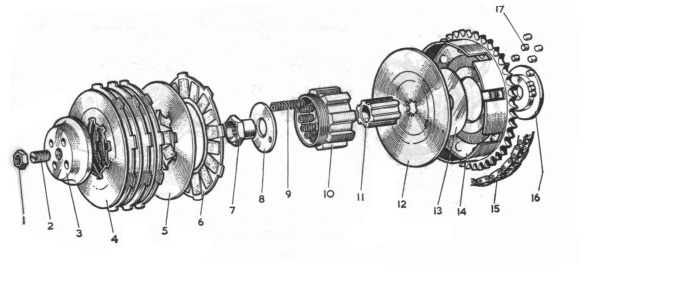
Here is my clutch
On my clutch the clutch basket whole has been turned out and a sealed bearing in the place of the rollers.
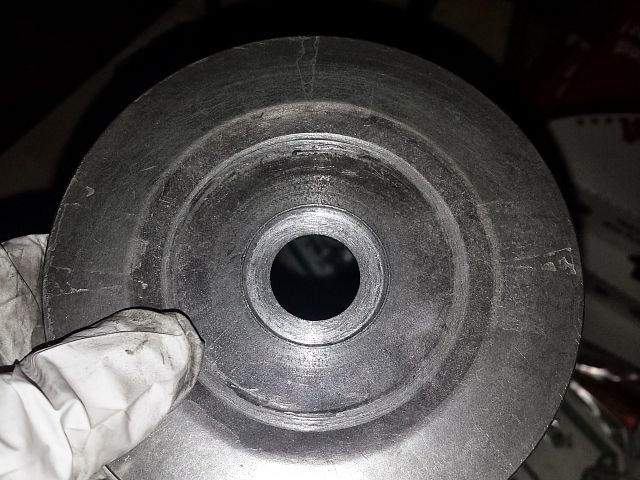
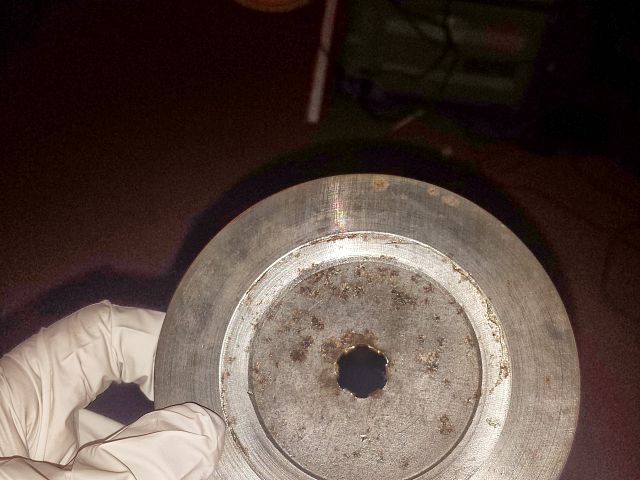
The metal swarf is coming from number 11 wearing a groove in number 12. Turns out that mine is missing the keyed slots in the middle of number 12, causing the backing plate to not run concentrically
I have a new backing plate on the way, but am wondering if this will solve the problem of number 11 wearing a groove in 12.
My instinct says to grind down 11 slightly so that its a bit shorter and doesnt press against the backing plate (12) but the force of the clutch springs will keep doing this. The bearing has added maybe 2 mm of depth, more than the rollers, but I dont think thats the cause.
Any thoughts?
Last edited by alexanderfoti on Tue Oct 08, 2013 11:48 am, edited 1 time in total.
Sorry, you see number 12 has a splined hole in the middle.
Mine is non existant. The guy at villiers serivices say its common for these to wear away, and then its not very obvious that they had slots in them im the first place.
A keyed hole in the middle of number 12 should resolve my problem as number 11 and number 12 always turn together, regardless of the currently clutch application.
Its only the clutch basket and the inner bearing/friction plates that turn when the clutch is fully dis-engaged.
The reason that mine 11 is wearing a groove in 12, is that the only things causing 12 to move are the friction plates and number 11 pressing againsnt it.
I would have thought that if the new bearing is 2mm wider than the original (and presumably protruding into the basket) then something would have to be machined to compensate for the extra material.
Can you get hold of another clutch to measure and compare the figures with the modified one?
Building the bike. Top of my list, bottom of the wife's.
Eddy Wane wrote:I would have thought that if the new bearing is 2mm wider than the original (and presumably protruding into the basket) then something would have to be machined to compensate for the extra material.
Can you get hold of another clutch to measure and compare the figures with the modified one?
The bearing is 2mm wider but the center piece sits 2mm back and has a milk carton type washer to keep it spaced correctly.
So even with the wider bearing, it's not protruding into the basket any more than the original roller bearings did
The result is the clutch is no longer jumpy, but still isnt realeasing fully (as per Tim). Thats the reason I cant find neutral, as the clutch is still slightly engaged (The center nut is jumping as you say Tim).
Adjusting the slack or the center nut just moves the biting point on the lever, but doesnt actually give any more slack in the plates. Any thoughts?
I dont know if this helps, but the one I converted to V belt drive. Because the vee of the pulley was not in the exactly same line as the original chain drive, when the clutch lever was pulled the driven pulley wanted to move on an angle as mine just has the original row of ball bearings which allows the driven pulley to move off the parallel. I cured this by fitting a hard nylon block that when the lever is pulled the pulley hits the block and prevents it twisting.
sbrumby wrote:I dont know if this helps, but the one I converted to V belt drive. Because the vee of the pulley was not in the exactly same line as the original chain drive, when the clutch lever was pulled the driven pulley wanted to move on an angle as mine just has the original row of ball bearings which allows the driven pulley to move off the parallel. I cured this by fitting a hard nylon block that when the lever is pulled the pulley hits the block and prevents it twisting.
Its funny that you mention that, becuase despite my best efforts to line them up, mine does this too!
I will give it a ago, a block of nylon with a thread on the end is a good idea!