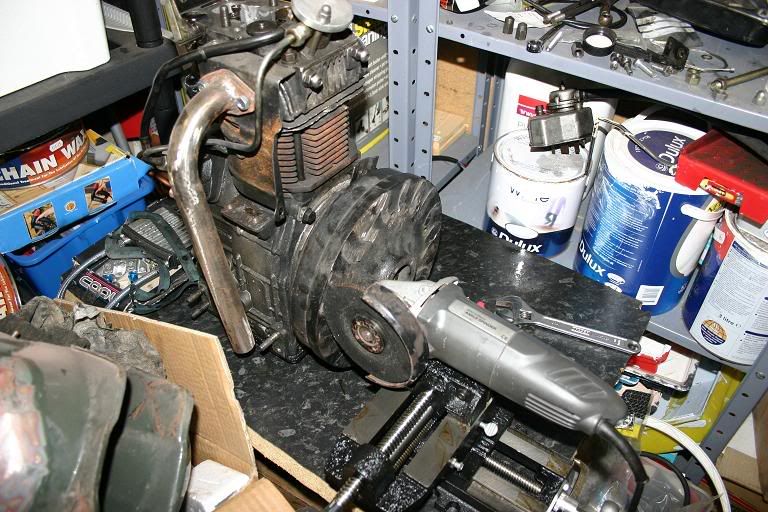
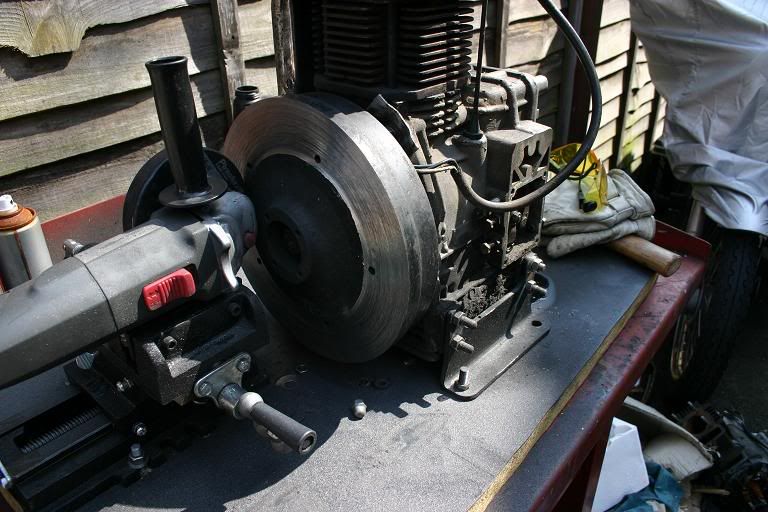
Now before you all go getting bent out of shape, see the size of the fins on the barrel?
That's because this is a version built for tropical environments so hanging out in the breeze in old Blighty should cause no problems at all.
I still need to find one of the automotive type injector pumps with the retard groove so it will idle and run ok with the lightened flywheel, or grind one up!
wont you need to get it ballanced after you grind some off it?
as fragile to vibration these bikes and motors seem to be, or at least I've been reading about, I don't think I would risk it. Get a local machine shop to lighten and ballance it. Shouldn't cost too much, definitely less than a motor or frame.
I'm going to rebalance with the 400cc piston to 58%. As I will then know the weights I can remove material from the flywheel to gradually go down to 55% and find out what the best balance factor is.
The flywheel is quite a complicated shape so making up one from billet will be very expensive, it's a keyway taper fit with a void in the back for the alternator rotor.
I'm just soo tempted to leave it visible afterwards just like a Guzzi Falcone......
Ah, if I had access to a lathe big enough then I would use one.
In the Uk we have sold off all our manufacturing capabilities, also all the colleges and schools have disposed of their equipment due to H&S issues so no evening classes either.
It's all a bit worrying, I've yet to see a computer make anything without being attached to a machine of some sort.
Won't affect the max rpm unless you mess around with the govenor weights & springs.
What it should do is to allow the motor to spin up quicker and get the HP working to accelerate the bike rather than the flywheel. Also removing the fins will be removing the air pump drag
I have seen a flywheel fall off a Guzzi falcone, it kept on running and rev'd like a 2 stroke - however it was impossible to start and you couldn't pull away from rest without it stalling.
Remember that stationary diesels are designed to be used on many different applications, their hardest task is usually starting with a complete load such as when fitted to a pump, in such circumstances you need all the flywheel help you can get your hands on; so construction needs to be able to cope with all these varied applications - hence the heavy flywheel.
Lightening the flywheel will make it more difficult to start and also give the regulator a tougher job maintaining idle or any other steady rpm, as it's only the idle I need the regulator to hold as riding is under twistgrip control.
In a motorcycle application you add a lot of additional flywheel type momentum with the primary drive, the engine sprocket, primary chain and the clutch all act as additional rotating weight, this is why racers much prefer lightweight belt drives.
Somehow I just knew this would cause some controvesy, just wait 'till I add a turbo to this single cylinder motor - that should get folks talking.
I only see people worried, mostly about your, shall we say imaginative contraption
On a more serious note, I think that this actually makes for interesting reading and I'm eager to learn how it pans out.
'92 Enfield + Hatz 1B40: street legal, weld up stainless exhaust, check engine rpm and change final drive sprocket.
as long as you have plans to get the rotating assembly ballanced, and the motor wont overheat, I have no problem with it. I needed to turn down a bolt to make a brake pushrod for my VW Scirocco when converting to manual brakes. I chucked the bolt in a standing drill press and used my small angle grinder to grind it to shape while turning. Looked great when done, and I now call it my verticle lathe.
my flywheel, clutch disk and presure plate on the Scirocco diesel I autocross weighs 15 lbs. Everyone keeps saying they've never seen a diesel rev as fast as mine does. The solid clutch disk makes it hard to take off smoothly tho. I've heard accelerating 1lb rotating equals 7 lbs static dead weight, but can't find the source to confirm on that right now.
I was planning to do this to mine some time ago, so I'm looking forward to the out come.
A diesel seller told me it would rev better (more responsive) but it would loose torque.
He also told me that it would idle at 800rpm if I kept it standard so to save fuel, but if I lightened it, it would have to be the normal 1000rpm or a bit higher tick over.
Maybe I could fit a flywheel from another Ruggerini engine in the same engine range, but slightly smaller. Hey Stuart can I borrow your flywheel?
Diesel Dave wrote:Ah, if I had access to a lathe big enough then I would use one.
In the Uk we have sold off all our manufacturing capabilities, also all the colleges and schools have disposed of their equipment due to H&S issues so no evening classes either.
It's all a bit worrying, I've yet to see a computer make anything without being attached to a machine of some sort.
Dave
When I moved to France, I brought with me my old Holbrook lathe, when I say old, it was reconditioned just before the last war, having been constructed to 'war finish' for the previous war. I think it will take 24" in the gap bed. I have used it often to skim car cylinder heads and drums in complete motorcycle wheels... It did necessitate a crane and a bigger lorry to move here, and on the drive over the lorry was rolling like a pig.
I am impressed with the inventiveness Dave.. Hope all goes well for you. I have to say I favour heavy as opposed to light flywheels because it makes for pleasanter cruising, even though it slows gear changes
There’s an age old debate esp on single cylinder motors like the diesel in question that a heavier flywheel smooths out the power pulses since you get one bang of power every 2 revolutions. The heavier flywheel with its inertia dampens the vibrations from power pulses keeping the motor running smoothly, but it is harder to accelerate and decelerate. Light flywheel the motor will take less HP, or KW for you metric folk, to accelerate and bike will accelerate faster.
The opening up arguments Dave mentioned in his first post is this: Constant speed cruising and initial starting from a dead stop heavy flywheel is nicer. Once bike has started to move and is in accelerating and decelerating commuting traffic, lighter is nicer. But, what weight is the best all round compromise? I’d say that is what Dave is working on.
The last piece of the puzzle is that a heavy flywheel smooths out the engine pulses as it accelerates slower.
Remember that in an otto cycle motor the power is only produced for a fraction of a single stroke of the 4 stroke cycle, the rest is just freewheeling around sucking power back out of the flywheel.
In order to take the snatches out of the drivetrain there is usually a shock absorber somewhere in the system, on old Brit petrol bike singles this was on the engine sprocket, on an enfield it's in the cush drive hub - on mine it's in both the clutch centre and the cush drive hub as you can buy an aftermarket clutch with a rubber cush drive in the middle.
Interestingly this is also the reason why singles work well off road, the power comes in big lumps and the gap between the pulses allows for traction to be regained by the tyres. Ever walked up a steep incline where the ground was loose (sand dunes). If you run at it pumping your legs than you usually sink in, if you power pulse your way up one step at a time allowing your footfalls to consolidate each time then you will usually make it to the top.
Is it acceptable to resurrect a threat after 7 years??????
It seems our friends in India have adopted Dave's free air approach to the little diesels powering their Enfields. And on an engine with head fins perpendicular to the slipstream, in a country not known for having a particularly cool climate. Following are a number of examples from the OLX Indian website where, lest you believe diesel bikes aren't on the market, you'll find 8 pages of mostly diesel Enfields for sale.